Sadly, as of August 2025, Ruhavik appear to have either broken or discontinued this service. I am still hopeful of getting something custom up and working at some point 😇
I was a little hopeful of the demo Traccar service as showing below, but that doesn’t seem to like being in an iframe!
The CARDIS—and hopefully we’re not too far away—is somewhere pretty close to the location on the map below (although the address it lists is not always accurate). Feel free to zoom/scroll around for more detail.
Techo note: after a fair bit of testing1 about the best I could come up with was to embed the Ruhavik2 shared page in an iframe. This seems to work OK but just needs renewal of the shared Ruhavik link every 12 months.
Note that in common with all (civilian) GPS, it’s only accurate to within 5 – 10 metres or so!
I’ve realised that our (my) memory isn’t what it was and the timing and sequence of events sometimes gets a little blurry over time. This post summarises some key dates/events starting from our decision to “retire’ (at the bottom of the page) with links to other relevant posts as appropriate.
(and remember that everything is written “bottom-up”)
2026-Jan/Feb/Mar: Survived Christmas/New Year 😇 18 Jan—heading up to Travelhome at Cardiff to rectify a persistent slide-room issue: see Cardiff 202601 for details. Eventually back to Granville, interleaving medical appointments and grandkid-sitting and helping some friends clear out their house to sell and move.
^ 2026 ^
2025-Dec: After just a couple of days at Tea Gardens we headed back to Granville, with a short diversion (couple of days) to Travelhome at Cardiff. See our 2025 Trips record. Catching up with kids/grandkids and preparing for Christmas and New Year and all that that involves…
2025-Nov: November was the “homeward bound” leg; still generally longer stopovers but also including the longest driving day we’ve ever done—over six hours and, in hindsight, too long! See our 2025 Trips record. Back at Tea Gardens by the end of the month.
2025-Oct: Less kms and longer stopovers in October—I think we realised somewhere around Mt Gambier that we weren’t enjoying the pace of the trip and wanted to take things a little slower (meaning that we didn’t get to Yorke Peninsula as we’d originally planned—maybe next time). Nearly three weeks in Tumby Bay catching up with lots of rellies. See our 2025 Trips record. At Rawnsley Park Station in the Flinders Ranges at the end of the month.
2025-Sep: Covered heaps of kms in September, with average stopovers of 3 to 4 days. See our 2025 Trips record for more detail, including a map showing the route. Had a fabulous week in the Adelaide Hills, not far away from Karen and Phil and family and were able to catch up with them a fair bit. Were in Port Augusta at the end of the month
2025-Aug: rolled out of Morisset on the 19th heading west and made it just past Merriwa before having cooling system issues (see our truck log for more details). Limped into Cassilis and stayed for nearly two weeks. Made it to Forbes on 30 August. See also our 2025 Trips record.
2025-Jul/Aug: went up to Port Macquarie to visit with Geoff, Lois and Lyndell, stayed at Bonny Hills. Back to Morisset as a prelude to a longer trip to Victoria and SA. Day trip to Parramatta for Brad’s 50th. See also our 2025 Trips record.
2025-Jun: sadly, Brett passed away on Tuesday 13 May (almost immediately after we had all seen him). His memorial service was on 13 June at the Singleton Showground. See also our 2025 Trips record.
2025-05-08/13: quick trip to Tea Gardens as as a base for visiting Brett and Liz in Singleton (along with Doug, Wes and Maureen ). Brett was not at all well and we were concerned that he had little time left. See also our 2025 Trips record.
2025-Feb/Mar/Apr: headed up to Tea Gardens as we needed to get the church website up and running. Mechanical weirdness along the way, but had a lovely relaxing stay in the Church grounds and really enjoyed the interactions with the church family there. Day trip to Penrith for Joel’s 40th. See also our 2025 Trips record.
2025-Jan: had a really nice Christmas/New Year, then headed to Camden for a couple of weeks to facilitate daily “Vera-sitting” trips (see our 2025 Trips record). [“Vera-sitting” is heaps of fun; she’s a sweetheart 😀 and a joy to be with—totally unbiased opinion of course!] then back to Granville for a few weeks
^ 2025 ^
2024-10-10/11-08: while at Granville, and with no warning whatsoever, Reen fell ill on Thursday 10 October. We initially thought it to be “just” a migraine, however in the afternoon she stopped responding to us. We called the ambulance who took her to Westmead Emergency, where she was diagnosed with meningitis/encephalitis. After 2 weeks comatose in ICU and another 2 recovering in the Neuro ward, she came home 29 days later. She’s needed further time taking it easy to fully recover but seems to be reaching a similar level of “wellness” to earlier in the year as we head into the Christmas break-time
2024-Sep/Oct: Reen wanted to be back in Granville for school holidays, so after a bit longer in Bourke with John and Hazel, we ambled in that general direction. See also our 2024 Trips record.
2024-Aug/Sep: “The Kidman Way” runs from just out of Jerilderie up north through NSW to Bourke (or perhaps the Qld border, it’s a bit vague!). We, with Richard and Heather, took nearly a month, seeing plenty along the way and having a pretty darn fantastic time. See also our 2024 Trips record
2024-Aug: we’d had a trip with Richard and Heather long-planned; the first part of it was getting to the starting point at Jerilderie, seeing and enjoying the country as we went. See also our 2024 Trips record
2024-Apr/Jul: headed to Singleton for Brett and Liz’s 20th anniversary celebration, then to Tea Gardens for our long promised R&R—70-odd days, so *very* worthwhile. Back to Granville for school holidays. See also our 2024 Trips record
2024-03-15/17: (2nd) knee replacement for Reen (left knee): this time it actually did all go very well and they sent her home on day 2 (the Sunday)
2024-Mar: back to Tea Gardens planning some more catch-up time, but on just our second day received an urgent call back to Sydney from Blacktown Hospital. See also our 2024 Trips record
2024-Feb/Mar: up to Travelhome (Cardiff) for some warranty repairs and finalisation of the decals, then to Tea Gardens (one of our favourite places in all the world 🙂 )for a short break. See also our 2024 Trips record
2023-Oct/Nov: we’d originally planned for a week or two at Morriset exploring the Central Coast and southern Newcastle, but had the first round of what seems to be a bit of an ongoing drama with the lounge-room slide out. See also our 2023 Trips record
2023-Sep: a trip out into reasonably familiar territory in central NSW—Bathurst, Gilgandra, Parkes—and back to Granville. See also our 2023 Trips record
2023-Jul: we headed back up to Travelhome for a few days for some minor warranty maintenance and to also get the first of the decals on the van and truck. See also our 2023 Trips record.
2023-Jun: Reen in Blacktown Hospital for a (supposedly simple) knee replacement. That bit was fine, it was the subsequent hernia/blocked bowel that caused the drama; she was in for nearly three weeks. See also our 2023 Trips record
2023-05-24: finally collected the van—yippee!! Short stays at Belmont and Tea Gardens before heading back to what would become our unofficial home base for the next (to date) 18+ months; the driveway of 13 Elizabeth St, Granville. See also our 2023 Trips record
^ 2023 ^
2022-12-25: all we want got for Christmas is COVID! Not impressed but made the best of it with Christmas Lunch with our friends through the kitchen “servery” window
2022-Dec: picked up our new Iveco, complete with tray, long-range fuel tank, extra “house” battery and 5th wheel hitch
2022-Oct: Dean finishes employment and becomes officially retired, we moved (back) to South Granville, to our friend’s granny flat
2022-Jul: Dean resigns from NSW Health and starts “cutting out” accumulated annual and long-service leave, we moved to Claremont Meadows (with Joel, Beck and Vera)
2022-May: contracted for an Iveco 50C210
2022-May/Jun: South Granville property sold for slightly less than we’d have liked but about OK for the market at the time
2022-Apr: commenced discussions for an order with Summer Life RV for their Drifter 29
2022-Apr: South Granville property listed for sale
2021-??: day-trip to Newcastle looking at 5th wheelers, etc. Found Jim at Summer Life and decided to buy new, rather than used!
2020-Apr—2021-Apr (or so?): what option is best for us? Long discussions with each other and both kids (and almost anyone else who would listen!). We finally settled on a 5th wheeler. In our “spare time”, sorted and disposed of 40+ years of collected stuff!
2020-Feb/Mar: we drove to Melbourne for a week, notionally to attend the Cisco Live event/conference. However due to (the beginning of) COVID19, this had been cancelled so we spent a week sightseeing. The 10+ hour drive home afforded us plenty of time to talk together and we agreed that we were both pretty much over the whole work thing and that retiring to “see Australia” sooner rather than later was the correct option; with the first step being to investigate caravan/motorhome options.
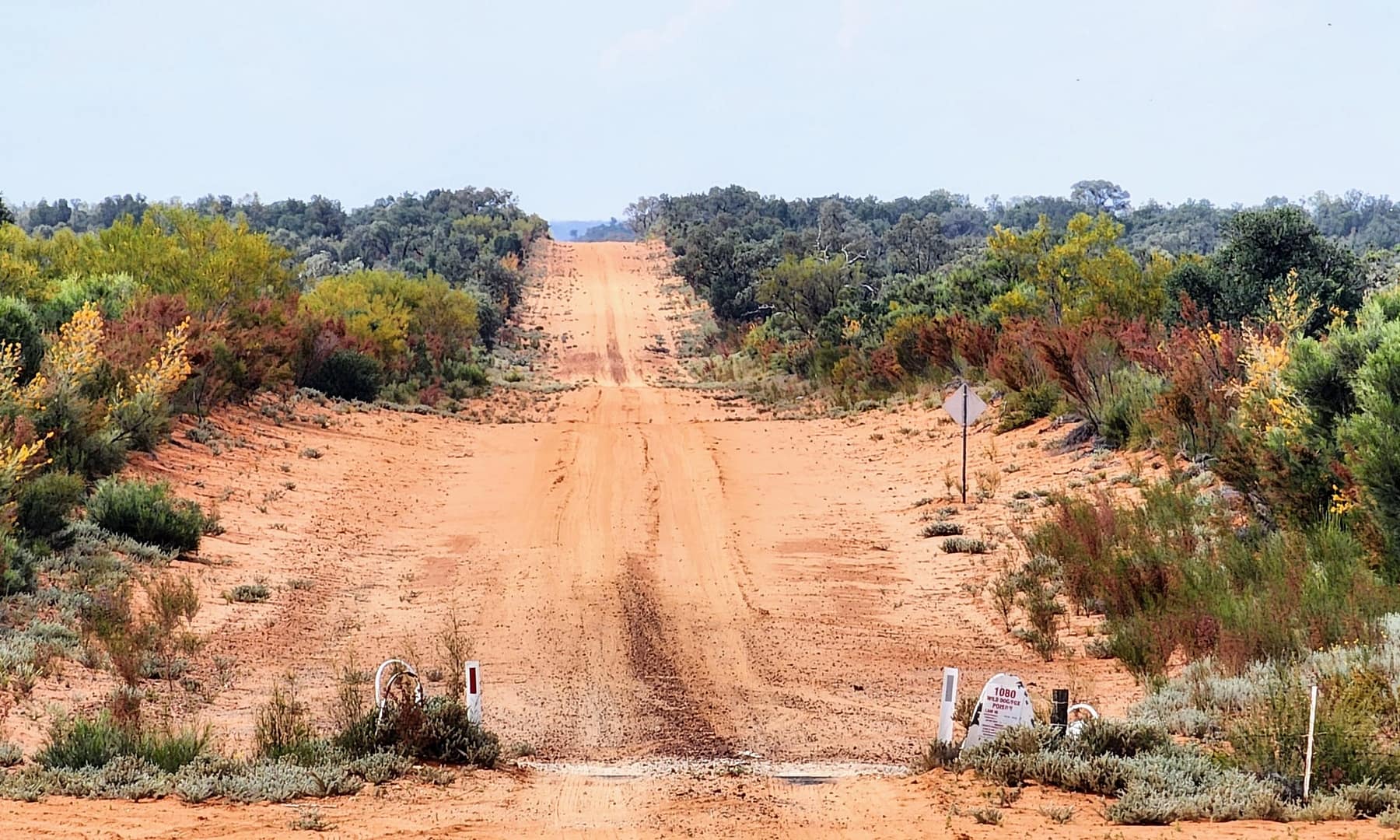
If you’ve not visited or travelled much into some of our country’s slightly more remote areas you might be tempted to think of the Australian “outback” as being fairly visually homogeneous; merely unending vistas of red dirt or similar. Having just completed about 4100 kms or so in a loop out from Sydney through Central-West NSW and back, we can assure you that nothing could be further from the truth.
Sure, there is certainly plenty of red dirt to be seen; but in the space of 50 or 100 kms you are just as likely to also come across salt-pan, rich black soil and white limestone-like sandy areas. Vegetation can range from tall conifer or eucalypt forests through medium height mulga scrub to sparse, low-growing salt bush and grasses. Throw in the abundant wildflowers that spring up everywhere after a little rain—especially in springtime—and there is scene after scene worthy of any Renoir or Monet’s time.
Some wildflower pics below, mostly from Ledknapper Nature Reserve north of Bourke—we hope they whet your appetite to get out and off the beaten track a little more.
One of the most common questions I am asked about the CARDIS is what mileage3 I get from the Iveco. Before answering that one directly, let’s consider a couple of related matters.
Driving practices
When towing on highways/good roads, I habitually set the cruise control at about an indicated 94-95 km/hr, which translates to about 91 or so km/hr true according to the GPS app I use for checking these things. Where road conditions are not conducive to this speed (e.g. lower limit posted, poor road surface), then I reduce speed accordingly. This latter circumstance has however, been definitely a minority of the time.
When not towing, I normally would cruise at or about the posted limit where reasonable.
Weights
The Iveco tares at 2760 kg, with a GVM of 4495 kg.
Weight in general travel configuration is about 3300 kg.
The CARDIS tares at 3740 kg, with a GVM of 4500 kg.
Weight in general travel configuration is about that (4500 kg) or perhaps a shade over4; although we’re working to bring that back to about 4300 or 4400 kg.
Combined weight in general travel configuration is therefore about 7800 kg, just a little under the legal maximum of 8000 kg.
Mileages
I’ve been recording fuel used since we bought the Iveco, and that currently stands at:
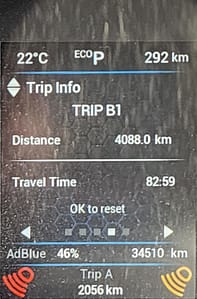
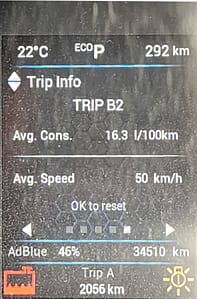
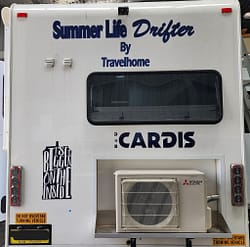
All well and good, but most of that 34-odd thousand kms was not towing, and towing the CARDIS is the scenario of most interest. That one is a little harder to nail down, but from a recent loop around NSW—Granville, Jerilderie, Bourke, Granville—of some 4100 kms or so, with about 2500 of that towing the CARDIS, we’ve seen an overall average of 16.3 l/100km6—see the two images below from the day we finished the loop. Specific checks on a couple of the legs gave just under 18 l/100km7, although I didn’t actually write this down anywhere 🙁 .
Do you “do” Church while you’re travelling, or on holidays8
?
I’ve gotta admit that for a long time, generally speaking, we didn’t. Sure, if we were holidaying with family, we often would go along with them (depending on which side of the family it was, of course); but if we were just travelling ourselves then finding a Church to try for only one or a small number of times seemed too hard.
So how does that all translate now that we’re pretty much permanently on holiday?
Some background: for 35 years or so we were regularly and strongly involved at Granville Baptist, later Granville Community Baptist. Over the last 20 or more years we’ve also had a strong relationship with Tea Gardens Baptist, and would attend there whenever we were up that way. We’re now starting to travel more as we “ease into” the permanent grey nomad lifestyle, and have just recently completed a 4000 km or so 13-week loop around NSW—basically Granville, Jerilderie, Bourke and back to Granville.
And we’ve attended 6 different Churches in 12 weeks (8 if we include Tea Gardens and Granville): Yass Baptist, Temora Baptist, Griffith Baptist, Cobar Baptist, Bourke Christian Church (Baptist) and Lightening Ridge Community Church (Anglican). All of these were very different to each other, with differing styles and forms of worship; some of which we were very comfortable with, others perhaps a little less so. All had time afterwards for “morning tea”, which we generally stayed for when we could.
Most importantly; I (at least, perhaps less so for Reen) came away from each service feeling refreshed and blessed, and encouraged by the evidence of ministry in that community.
So, next time you are away from home and your “regular” Church, why not take a chance on a local Service, you may well be pleasantly surprised, encouraged and blessed.
As you might realise, we’ve spent a good deal of our life in Granville: originally this came under Parramatta Council, more recently it was with Holroyd. In both cases there were robust recycling schemes implemented for household garbage, covering such materials as paper/cardboard, most metal items and plastic milk/drink bottles. We worked fairly diligently at utilising this, with Reen even insisting that containers be washed/rinsed out before gong into the bin.
Hence it’s been a bit of a “culture shock” to find that, as we’ve travelled around, lots of places don’t appear to have any form of similar scheme operating. Sometimes there does appear to be recycling at the domestic level—yellow-lidded bins in the streets—but nothing for the caravan park or showground that we’re staying at. When I go looking for reasons mostly I can find none stated, although in one case the site owners/operators note that waste collection is not by the local Council but by private contractor.
Quite a few places have some arrangement in place for the 10c refundable items, usually managed by a local charity such as Lions or Rotary; and these seemed well supported :).
I’ve noted also that the further we get from “civilisation”, the less likely any recycling scheme.
This all raises the question (in the words of a famous professor): why is it so?
Are travellers unable to separate recyclable goods from genuine landfill? Perhaps because their “home” environments are so different from each other that they genuinely don’t know? [This seems like a pretty long bow to me!] Is the percentage of boofheads and drunken yobs in the travelling population so high that recycling is too costly?
Leaving aside the song from the 1960s musical/film Sweet Charity, watching the comings and goings at a couple of showgrounds this trip has got me wondering: what pace do people live at that drives them to only stay at a place for a single night?
I know we’re only really new at all this caravan tripping/grey nomad stuff, and this is really only our second serious trip, but it only took us the trip down to Echuca last Christmas to realise that staying only overnight left us feeling rushed and frazzled and worse, denied us the opportunity to see what a town had to offer. For the trip back up after Christmas we stayed two/three nights at each place, which was better; and this trip we’re planning between four and seven nights in each location (and we’re currently part-way into our second stop of a week).
However, I’ve been amazed and a little bemused by the cyclic turn-over at each of our two stops—by far the majority of people are only in for a single night. I’ve not really kept numbers, but I’d guess that majority to be as high as perhaps 80%. I don’t think it’s demographic-related, as even though most travellers are couples visually of about our age-range (±10 yrs or so 🙂 ) with a smattering of singles and families, the short-stay syndrome seems to cross those boundaries.
Relatedly, scanning a couple of fifth-wheel-related groups on Facebook shows a similar pattern, with perhaps a lower percentage of short-stayers (that could possibly be explained by the larger size and greater liveability of fifth-wheelers in general).
As I noted in the “Lessons… learned” section of our review of our first 12 months, we’re definitely happier living at a little slower rhythm. If you’re reading this, maybe you should try it, you just may like it as much as we do!
As we come up to 24 May 2024, marking the first anniversary of collecting our van and living in it full-time, it’s a good opportunity to reflect on how things have gone over that period; what we’ve learned [Spoiler: lots], things that we really love about the van (and truck) and things that we’re maybe not quite so keen about.
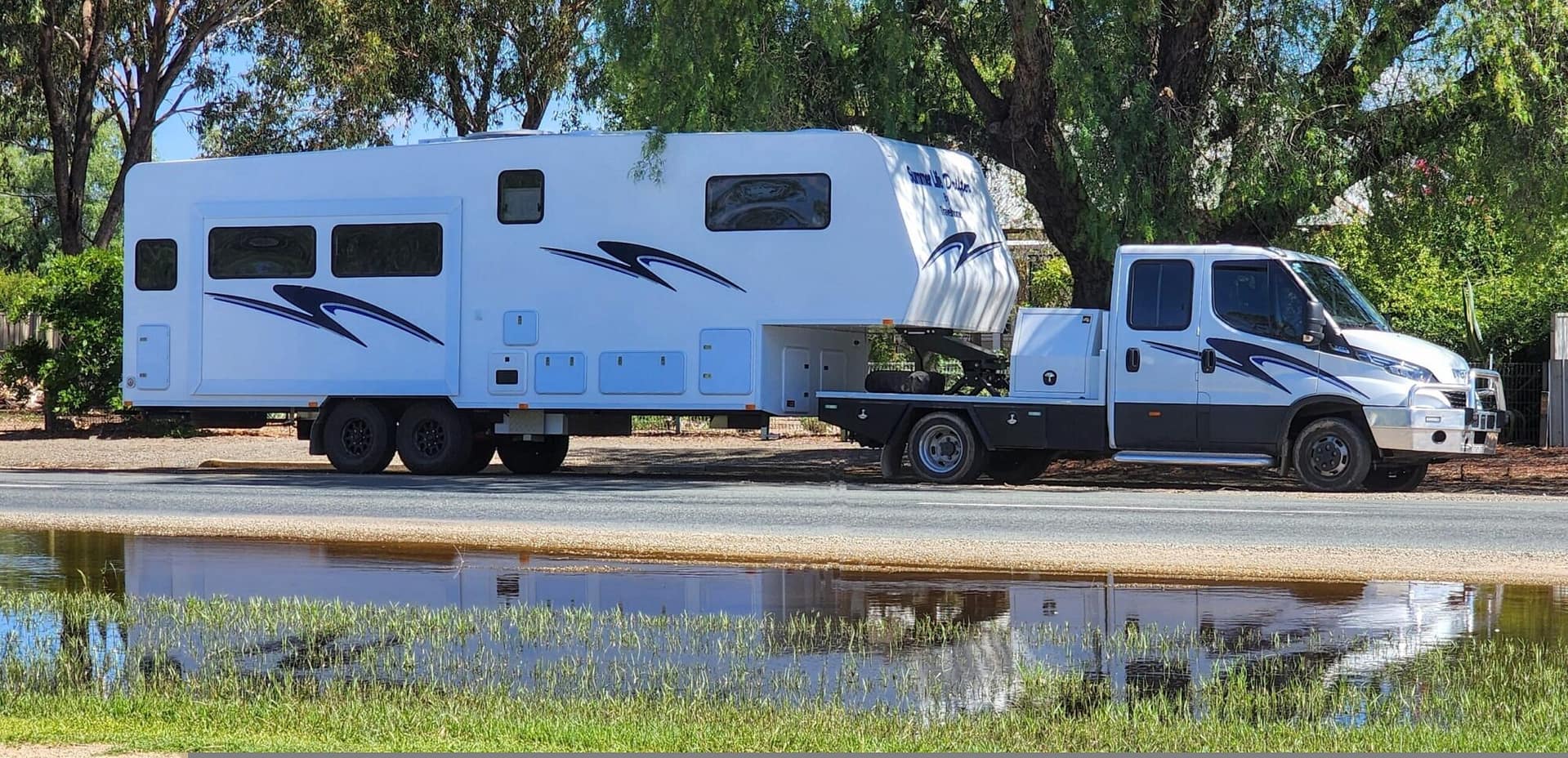
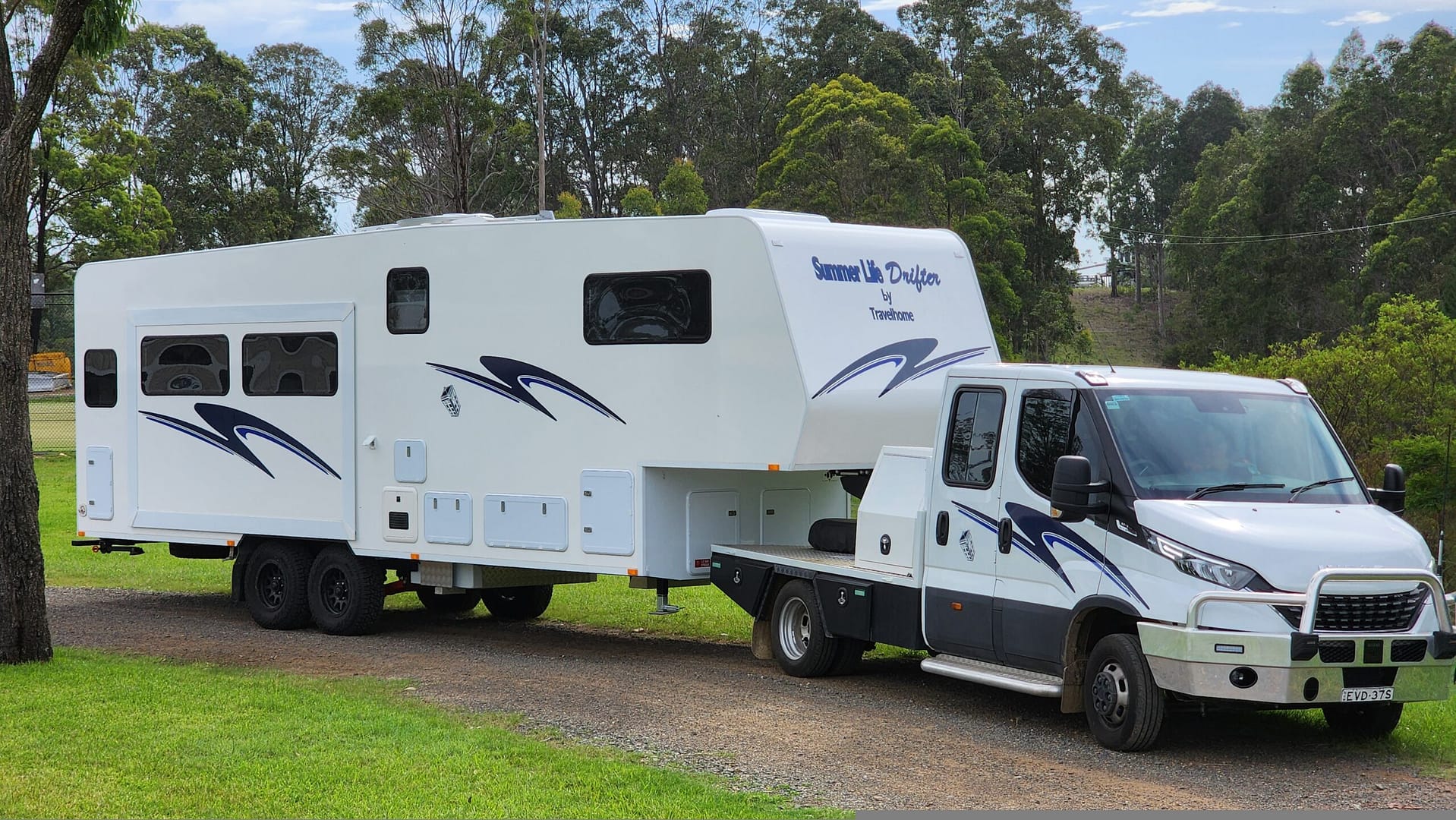
First an overall pic of the combo at (about) this time.
Read on…
Lessons we’ve learned
We should start this bit by noting that neither of us had **ever** owned or lived in a caravan previously9. This means that we came into the whole deal with lots of background reading and a reasonable amount of discussion with some seasoned travellers, but no practical experience whatsoever. As such, everything that we may know now has pretty much come home over this 12 months!
So, in no particular order, here’s some of the key things we’ve learned…
Driving in our truck is just like, well, riding in a truck. OK, sounds obvious I guess, but I don’t think we actually appreciated the (lack of) ride quality and size of the vehicle, etc.—despite having had the truck for nearly six months before picking up the van. Which brings us to…
This combo is big, really BIG! I can just see all you semi drivers out there rolling your eyes at this, but take a deep breath and stay with me 🙂 For us—me in particular as Reen hasn’t driven the combined rig yet—punting around 14 – 15 metres is reasonably challenging. I can’t say that I’ve ever yet been in an uncomfortable situation with it, but it certainly has been a “learning experience”. Planning ahead and walking around/through any slightly restricted areas such as caravan parks and other parking spots seems to be the key to success. Reen has also become highly competent in giving directions and is rapidly learning the clearance needed for swing/arc of the van, etc.
Plan, plan, plan and plan some more; but don’t be upset if everything around those plans changes before you get there, or even anywhere near there. Two examples come to mind: the first was that when we were waiting on the final completion of the van, we were expecting to collect it and head out into the wild brown yonder. A couple of months before pickup, our daughter was diagnosed with breast cancer, which immediately refocussed us on supporting her and husband and four kids for the foreseeable future. As such, we spend a large part of 2023 in the van in their driveway (in beautifully scenic downtown Granville 🙂 ). Now coming up onto 12 months Nyssa has been declared “cancer free”—Hallelujah!!!—and we are getting back to thinking more about travelling. Which brings us to our second example of plans changing; in early March we had just settled in on our friends property at Tea Gardens, intending to spend about a month unwinding. The day after we arrived (a Wednesday), Reen received a call from Blacktown Hospital asking if she could be ready for her second knee replacement the coming Friday (i.e. the day after tomorrow)? An immediate rush to pack-up and return to Granville ensued, with Thursday then spent chasing around x-rays and the surgeon, etc.
Any cupboard door that can open will open—and the corollary, anything that can jump out of a cupboard will jump out of the cupboard—mostly we guess relating to the wonderful condition of the goat-tracks laughably referred to as “highways”, to say nothing of other, lesser-class roads. This also comes with a critical secondary lesson as well: on arrival if any cupboards appear to have opened, check and double- and triple-check around the slide-rooms *before* you put them out. (Not that we would know what might happen if something like a jar of Vegemite became wedged under a slide-room or anything…) Anyhow, mitigation of this matter becomes a combination of careful checking that all cupboard catches have clipped properly before leaving, extensive use of non-slip matting on the shelves and fitting some inexpensive child-proof drawer latches to any non-locking cupboards [AND driving more in line with the road conditions AND not storing certain things in especially vulnerable cupboards 🙂 ]
Live small and live tidy. Everything we own is now in the van and truck, and to be honest, we still have too much stuff. It’s really hard to get out of the old “hang onto it ‘cos you might need it later” mind-set, but I think we’re getting there. And if everything has a place and you make the effort to keep it in that place, packing up to move along is much, much easier. We’re probably still not quite as good at this as we could be, but it generally only takes us about an hour to “break camp” after a reasonable length of stay (several days/weeks) if we push along; although we usually pace ourselves and take a little longer.
Live a little slower. This may be something that comes along with being retired, but we find that not trying to rush things along makes us much happier. This means that we don’t try to drive at freeway/highway speeds, but a few km/hr slower (saves fuel too 🙂 ); and we try not to stay only a single night in any given location unless there’s good reason to, as it doesn’t give us time to look around and enjoy our fabulous country. In fact, in general we’re now tending towards weeks in any one spot, rather than days.
Things we love about our new home
As noted above, we’ve never ever “caravanned” before, so we came into this with some degree of trepidation; what if we hated the whole thing after 3 months? what if we couldn’t deal with the constant change (of location, etc.)? what if everything was too crowded?, what if…??
Suffice to say, we’ve made it to 12 months and—in general—we absolutely love it!
Some of the things we especially like…
How it looks. As per the picture above and a couple more below, we reckon it’s a pretty darn good-looking rig. It’s taken a while, getting toward the whole 12 months, but we’re really happy with how it’s all now looking, especially my inside door Christmas present.
The size and how comfortable it all is. OK, as noted above, it’s a big rig; the up-side of that is that we have lot’s of room inside. At about 25 m2, it’s getting on towards what one might get in an inner-city bed-sit, and certainly more than the average caravan. This expansive size allows us the degree of otherwise unexpected comfort, such as two leather electric reclining lounges, a proper reverse-cycle air conditioner, a 50″ TV, a normal household-sized shower cubicle and a full queen-sized bed—without feeling in any way crowded or confined. All of this has meant that our transition from house to van has been remarkably easy overall and living is very, very comfortable.
The overall design. One of the things that impressed us both when we first looked at Summer Life RV (which became Travelhome) was the obvious experience and thought that had been put into the layout and build. The location and size of cupboards made them accessible and useful, without crowding the living space. The benchtop material is beautiful, yet tough and not-too-heavy. Light switches are all wireless and set out logically in line with the light’s locations. There is no wasted space, with every last little bit accessible for storage. And the list goes on…
Relatedly, how easy to clean/maintain everything is. All of the inside surfaces are very simple to clean and need almost no other maintenance. Vacuuming takes less than 15 minutes with our Dyson stick, and mopping the floor afterwards a similar time.
The amount of storage space we have available. OK, related to the size and design of the van as noted above, but worth calling out separately because it’s a key issue for us—and lots of other people I suspect. So, as well as all of the cupboards in the van, we have space available under the lift-up bed (although it can be tricky to get to things right up near the head) and even after using a fair bit for our cats, stacks of storage in the underfloor bins (or boot, as we call it!). That space is generally able to hold about 14 x 55 litre storage crates, plus a couple of other odd things such as a spare toilet cassette, etc. We have to keep telling ourselves to NOT fill it up just because we have the space…
All of the different views we have from our kitchen window. It may be really, really obvious but the whole point of living in a van is to be able to move it around. We’ve not done that as much as we would’ve like this past 12 months, but we’re really looking forward to getting “out there”. Thus far we haven’t had a bad experience at any site (I guess that may well come) and we desperately want to continue the adventure.
Things we don’t love quite so much 🙁
It wouldn’t be quite true to say that we love every aspect of living in our van, but we must say that none of the following points are particularly significant, more like a couple of niggly, whingy little nit-picks. Feel free to skip this bit if you like…
Dunny duty. I suspect no one actually likes this; but it is really difficult to see any way around it, it’s kinda one of those necessary evils that are a part of life. Still, it isn’t actually all that hard or that disgusting and usually only takes a few minutes (depending on where the dump point is located). Advice from The Guru10 has helped us reduce the frequency of this task a fair bit and having a second cassette facilitates a more flexible approach to emptying. At the end of the day—it is what it is!
Cost vs capacity of mobile internet access. Having grown into permanent broadband internet connection through all the various technical stages from 9600 bps dial-up all the way through over 35+ years, the reality of the cost vs capacity of available mobile connections came as a bit of a rude shock. We’re currently surviving with a low cost/medium-low capacity SIM in the router, supplemented by tethering to our phones when reasonable (we both have stacks of accumulated data capacity) and “leaching” free wi-fi when we can. Only time will tell if this is long-term sustainable.
Our perfect home
So, have Summer Life/Travelhome managed to create a perfect home for us?
Sounds far fetched, but it’s not too far from the truth. Could they have done some things a little better? Sure, but in general there are very sound sourcing and economic rationales behind all of the decisions. Bear in mind also that our build took place through the COVID years, which meant that, along with the build delay, there had to be an occasional decision around components of the build that was different to their original plan. Mostly this only meant different, occasionally it meant better and they worked really hard to ensure it was never worse.
So is it perfect?
Well, for us at this point, maybe it really is (or as close as we can reasonably expect to get…)
This is part one of ?two? that describe how I’ve managed to cobble together tracking the location of our van, the CARDIS. This post describes the configuration of the Teltonika router in the CARDIS to output GPS coordinates in a format that is vaguely reasonable to use without investing in a full-blown AVL11 system.
Router capabilities
The Teltonika RUTX11 is one of a range of Teltonika’s industrial-grade routers that has GNSS (location tracking capabilities built-in). It also has a range of other, industrial-oriented features such as support for Modbus and MQTT, as well as Bluetooth.
Required output
As noted above, I didn’t really want to build/install/maintain a full AVL system—firstly it’s overkill for this really straightforward requirement and more importantly, it would need to be a hosted system to ensure half-way reasonable uptime/reliability and that starts to become complex and expensive (relatively speaking, against our very limited budget). We already maintain a hosted system that runs this website and our family tree software, so using it seemed to have some advantages. As such, I hunted around for a WordPress plugin that seemed to meet the need and settled on “Trackserver” (not that there is actually a huge number of relevant ones out there so far as I could find).
Trackserver (being tied to WordPress) requires HTTP(S) input, but recognises and accepts a fairly wide range of formats and message structures: mostly relating to other commercial or open-source tracking systems or devices. Unfortunately from my perspective, documentation of these formats seemed somewhat scarce (read essentially non-existent), which made it rather difficult to set a target for what was needed out of the Teltonika.
Eventually I got to the point that I could get, and should be able to configure Trackserver to use, an HTTP POST with a JSON payload.
Teltonika GPS output
Sadly, the doco around the Teltonika router functions, while reasonably comprehensive, seems to have been written by an engineer with English not as their primary language. By this I mean that although the doco is technically correct, it almost always stops short of fully describing the function in context. For example, there are lots of points similar to: “The On/Off slider is used to enable or disable function_xxx. When the slider is in the “On’ position, function_xxx is enabled.” This is 100% technically correct, but hardly useful unless you already know what exactly function_xxx actually does. And if I knew what function_xxx did, I really wouldn’t need instruction on how to use a web-interface slide switch! Add in the occasionally fractured grammar…
Anyhow – end of rant.
Screenshots in this post are from v7.06.6 of the firmware, which seems a little less user friendly than the previous one; although it does seem to have improved stability of the system, which is a really good thing :).
The Teltonika router appears to have several ways of getting GPS info out to an external system:
Services > GPS > NMEA:- this seems to offer options for sending (forwarding) NMEA standard messages (sentences) as a non-HTTP variant of TCP. It was unclear if sending to port 80 would actually mimic HTTP, and in any case the NMEA sentences require translation before use and I could not find any relevant WordPress plugins for this. See Figure 1 below for an example of the output (only 2 of the 5 available GPS sentences shown);
Services > GPS > HTTPS: promising, however no matter how I configured this I could not get it to send anything other than the full suite of sentences whether they had collected any data or not, plus the same issue with translation of the NMEA data noted above. Also seemed to send 10 or 12 sets of the data at once. See Figure 2 below for a truncated example of the output;
Services > GPS > AVL: presumably for use with a proper AVL system; in fact I managed to get it working with Ruhavik (which I know nothing about other than it seems―at time of drafting—to be free for limited personal use). As for the NMEA option above, it appears to use a non-HTTP variant of TCP;
Services > MQTT: again, seemed promising as it can access/transmit GPS data, however it is definitely *NOT* HTTP and the only general MQTT plugin I could find for WordPress was very much a developmental work in progress;
Services > Modbus > Modbus TCP Server & Services > Modbus > Modbus TCP Client: I’ve never had anything to do with Modbus previously, but this seemed promising, especially as it can read/transmit GPS selected data;
Services > Data to Server: offers translators/connectors between Modbus and HTTP—seems to be just what we need 🙂
As it turns out, after extensive reading and piecing together various forum questions/answers, what I needed is the last two of these together.
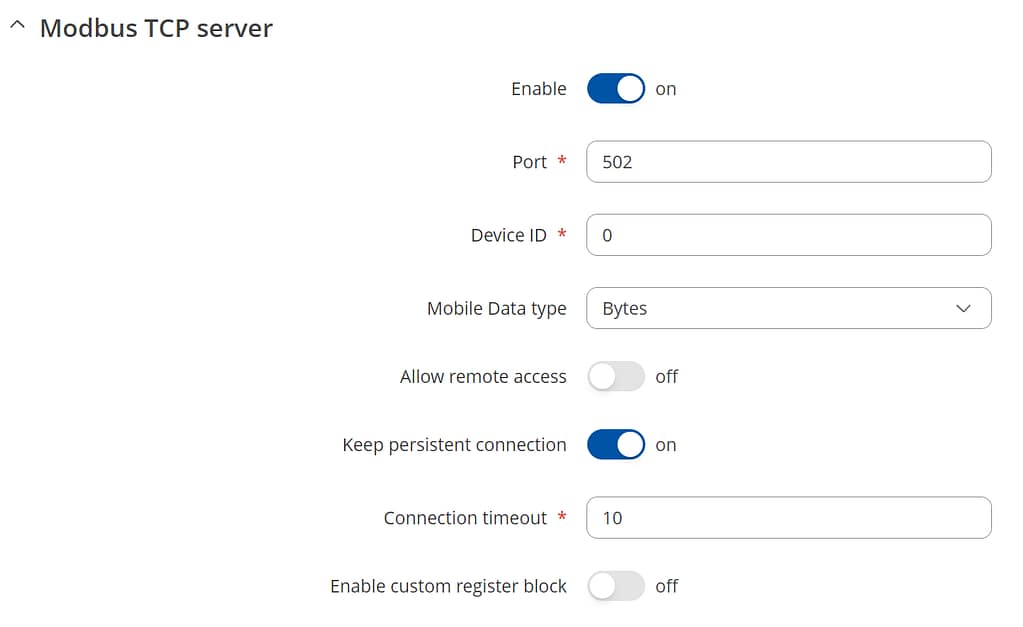
Modbus Configuration: Server
Figure 3: Modbus Server config
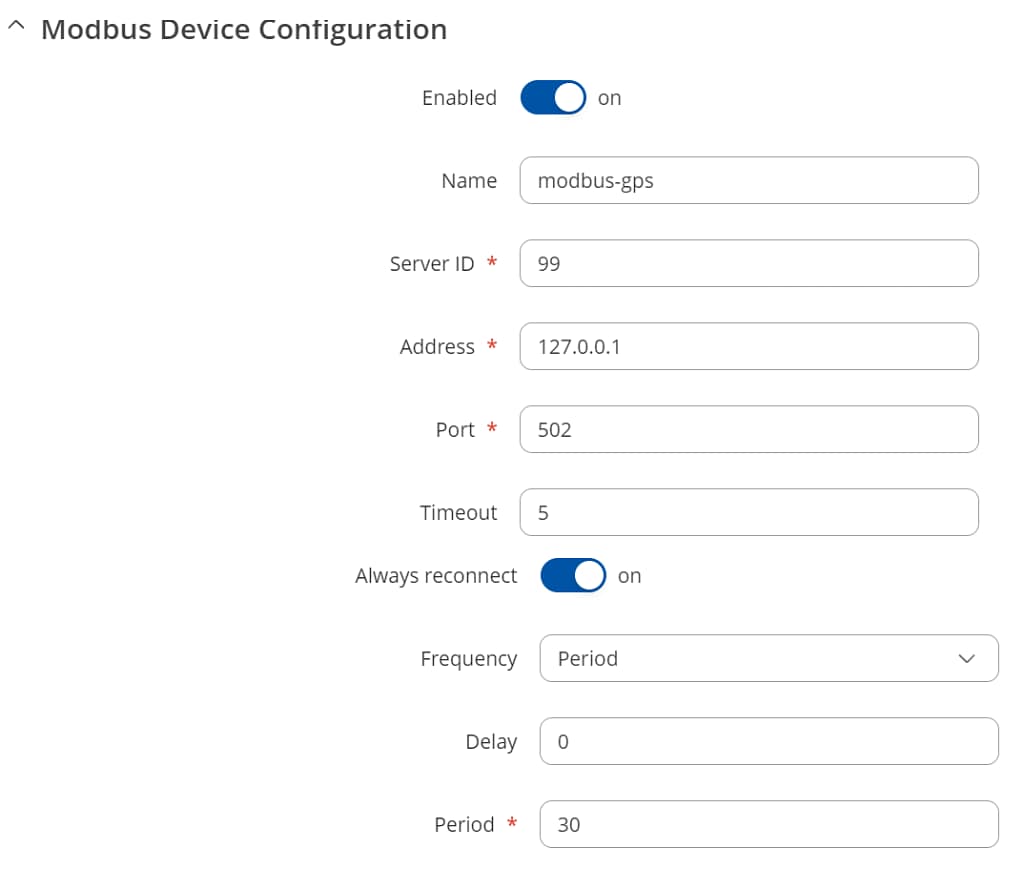
Modbus Configuration: Client
Figure 4: Modbus Client config
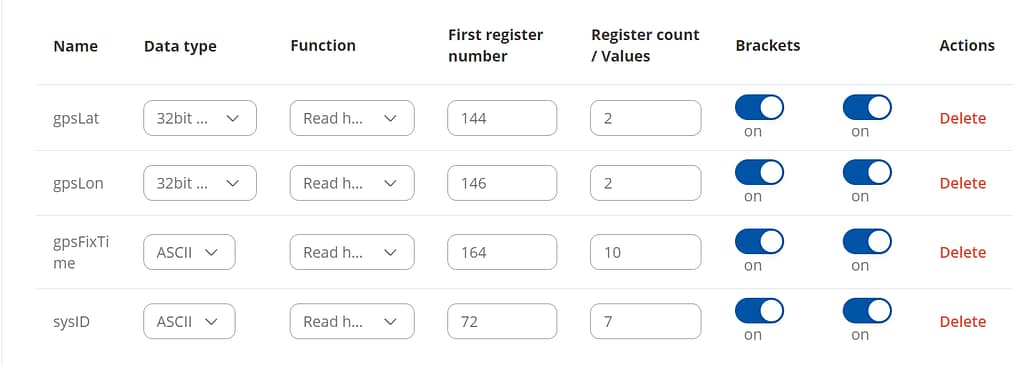
Figure 5: Modbus client config detail
Figure 6: Modbus client config – more detail
Data to Server Configuration
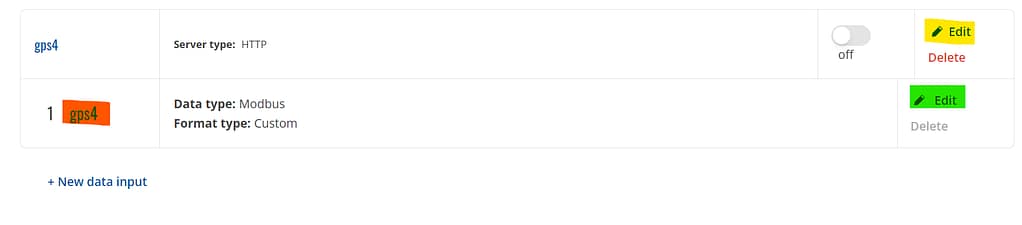
Figure 7: Data to Server – initial
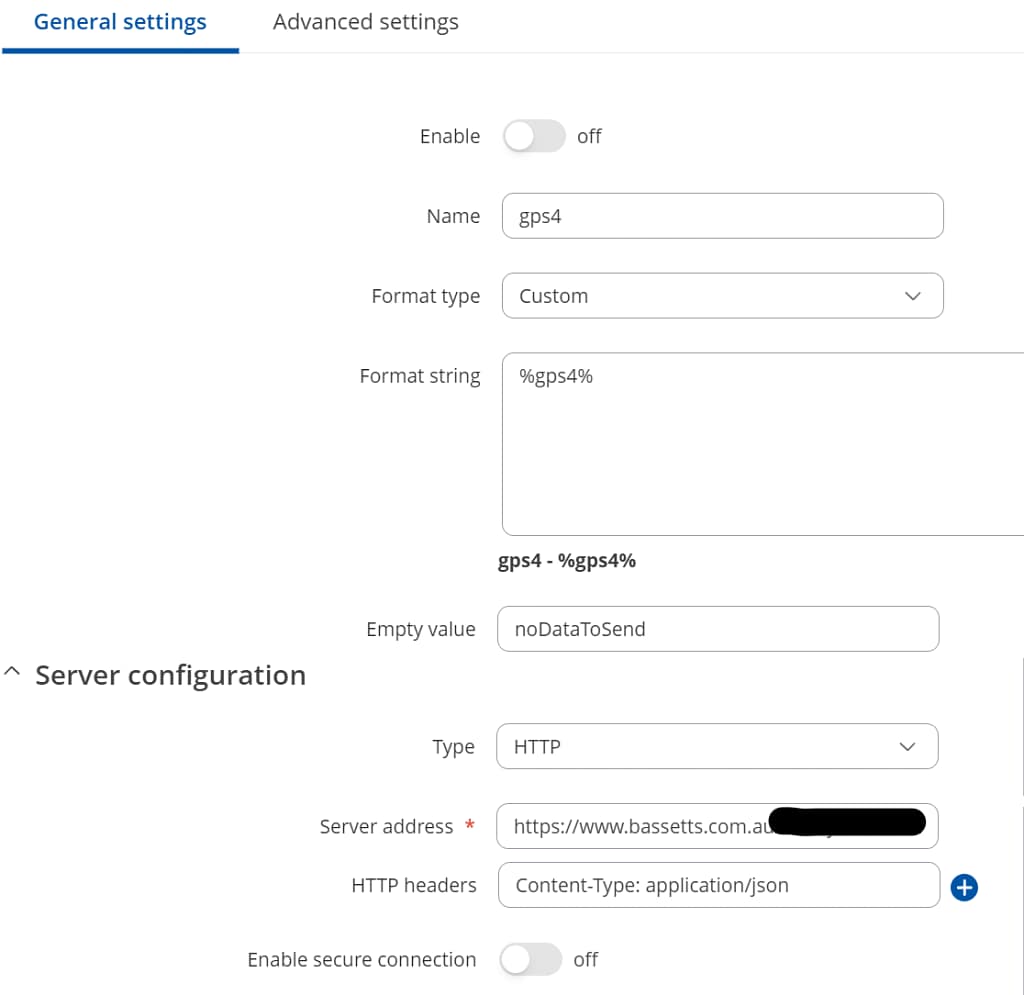
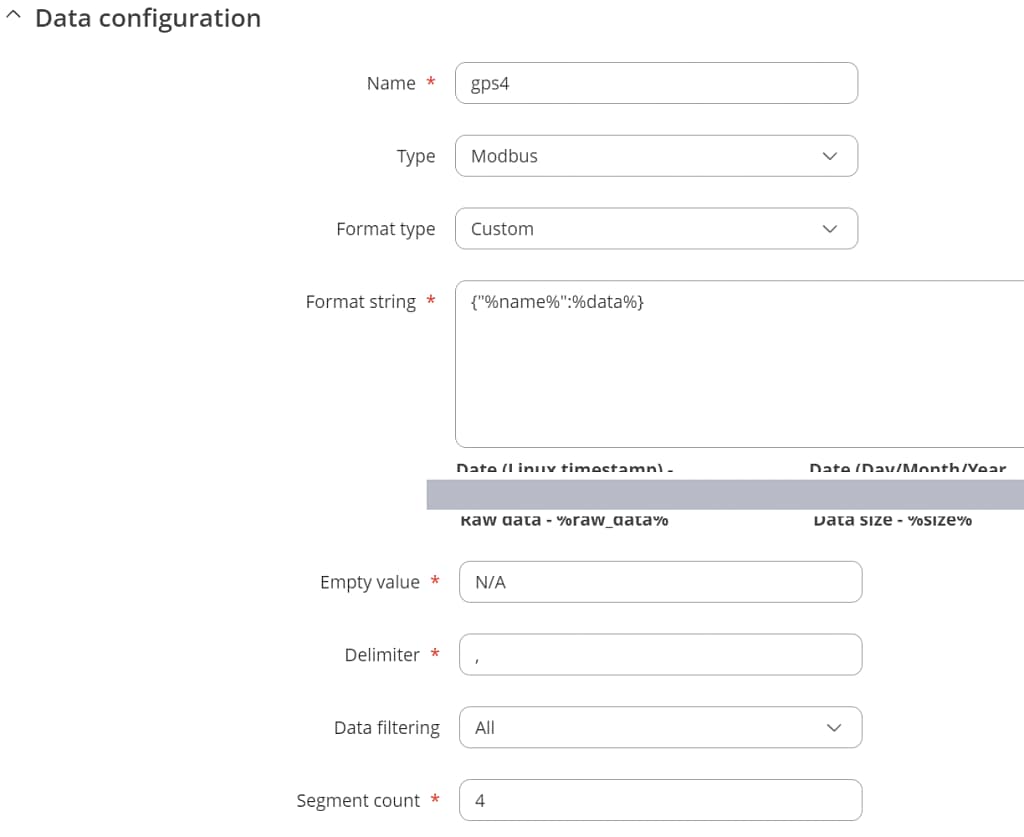
Note that the RED highlight above is merely a label and isn’t particularly critical, it’s just used as per Figure 8, below. The YELLOW and GREEN highlight details are shown in Figures 8 and 9 respectively.
Figure 8: Data to Server – YELLOW config
Figure 9: Data to Server – GREEN config
What comes out from all that
When configured as above, the output is an HTTP POST with a JSON payload, as follows: