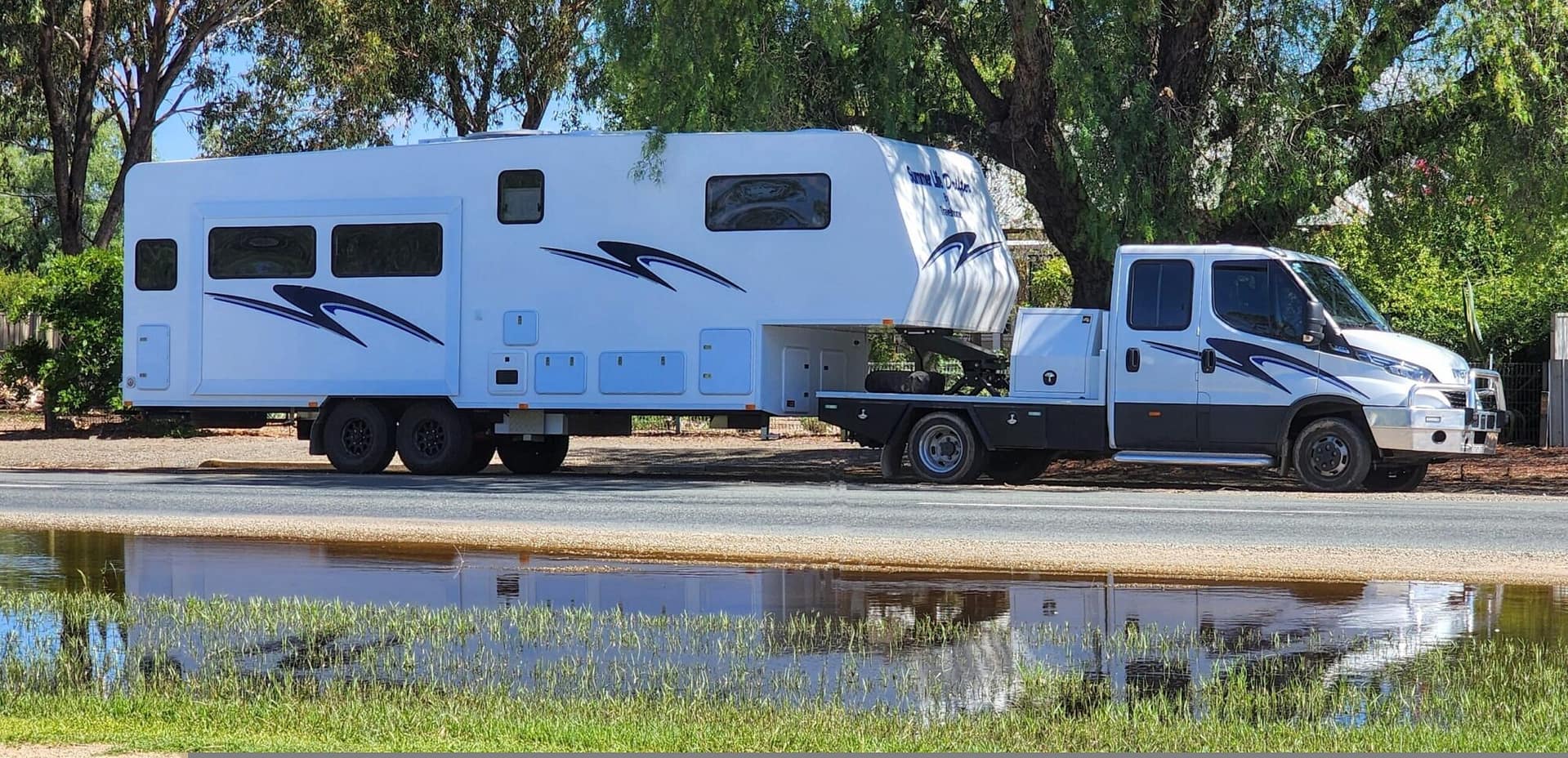
* in the second meaning ("silly or high-spirited behaviour;
mischief", with the emphasis on "silly") according to Oxford.
Intro
As previously alluded to in “Truck and van”, trying to get hold of some documented clarification around the legal and regulatory definitions, specifications and status of a 5th wheeler and tow vehicle was a hopelessly frustrating exercise.
There is some very small glimmer of hope on the horizon, as it seems evident that there is a desire and will for Australia-wide convergence of the regulations and related matters. However, all regulatory process move glacially slowly, so holding your breath in anticipation of an outcome is probably not a great plan.
Useful reading
Some documents I found that proved helpful are:
- Australian Department of Infrastructure, Transport, Cities and Regional Development VSB 1 – Trailers with an Aggregate Trailer Mass of 4.5 Tonnes or less
- Transport for NSW Vehicle Standards Information #5, Light vehicle dimension limits
- Transport for NSW Vehicle Standards Information #18, Dimension and mass limits for vehicle combinations
- Collyn Rivers “Fifth Wheelers are Safer” page (downloaded PDF as of Jan 2024). I also **strongly recommend** Collyn’s The Caravan & Motorhome Book; it’s a good read and jam-packed with solid, technically robust information.
- Caravan Industry Association of Australia’s “5th Wheeler Towing” (downloaded PDF as of Jan 2024)
- CarsGuide “Vehicle weights explained” (downloaded Jan 2024)
Key foundational facts
Some of the interesting, relevant and usually not-well-understood facts that I uncovered in this research are:
(a) A 5th wheeler is defined as a semi-trailer—see sections 3 and 4 of Ref #2, above. As such, when combined with the tow vehicle it forms an “articulated vehicle” as distinct from a “combination”.
(b) While Ref #2 notes the differentiation between “light” and “heavy” vehicles and refers off to other sources for weight (mass) limits for the heavy class; there is essentially no discussion in that document or any other (such as the referenced Regulation) of such limits for light vehicles, other than the upper limiting point of 4.5 tonnes.
Note: Ref #3 is provided primarily for interest only as it refers and applies only to “vehicle combinations”, NOT “articulated vehicles”.
(c) “Towing limits” are (within reason) defined by vehicle manufacturers not regulation and are almost always a function of the engineering of the tow hitch and it’s attachment to the vehicle.
(d) Applying the same logic to a 5th wheeler shows us that the absolute upper limit of tow capacity is that of the hitch (e.g. 7 tonnes for a commonly used Hayman Reese unit). Referring to (b) above [and hence Ref #2], this becomes 4.5 tonnes to stay within the light vehicle definition.
(e) A 5th wheeler “transfers” some 20% or so of it’s overall weight as load onto the tray of the tow vehicle—see the definition and picture of semi-trailer in Section 3 of Ref #2. The “20% is notional and will vary depending on build and user-loading, but is generally considered close enough by the industry; Refs #4 and #5 confirm this. Thus, for a 4.5 tonne 5th wheeler, some 900 kg (plus or minus) should be expected to need to be borne by the tow vehicle as tray loading.
(f) As is the case for any specialisation, this area is littered with confusing and seemingly irrelevant/contradictory/overlapping acronyms. Ref #1 covers off some of these authoritatively, and Ref #6 is a well constructed summary, albeit from a journalist rather than a regulator.
Australian vehicle specs
In light of the above [esp (e)], it’s worth having a quick look at the payload capacity of some classes of vehicles commonly available in Australia and used as 5th wheeler tow vehicles (or prime movers).
(all figures from carexpert.com.au or drive.com.au or similar)
Normal single or dual-cab utes:
- 2023 Toyota Hilux, SR5+: 940 kg
- 2023 Ford Ranger Wildtrak: 997 kg
- 2023 Isuzu D-Max: 985 kg
“Smaller” American pickup trucks (1500 class):
- 2023 Chevrolet Silverado LTZ Premium: 756 kg
- 2023 Ram 1500 DT: 779 kg
- 2023 Ford F-150 XLT LWB: 794 kg
Neither of these are looking good for being able to legally and safely deal with a high-end 5th wheeler (one of 4.5 tonne or thereabouts).
[As an aside, it’s worth noting that most or all of these vehicles have third-party GVM upgrades available to add a further 500 or so kg to the payload capacity. However the cost and fitting/approval process are non-trivial.]
Light trucks:
- Iveco Daily 50C Dual Cab: >2100 kg (varies slightly depending on model)
- Renault Master: ~2100 kg (most info addresses the van variant)
- Mercedes-Benz Sprinter: ~2800 kg (converted from pounds!!)
It seems fairly obvious that if you really want/need a 5th wheeler that approaches the upper limit of 4.5 tonne, then this class of vehicle is a far better (really the *only*) option.
Some hypotheticals
Assumption: you will have approx 300 kg of payload “pre-allocated”, consisting of (say) two reasonable sized Aussie adults and a bunch of other tools, food, dog(s), etc whenever you are towing your 5th wheeler.
Case 1: normal Aussie ute
Available payload = ~950 – 300 kg = ~650 kg.
Maximum 5th wheeler ATM (see Ref #6) = 5 x available payload = 5 x 650 kg = 3250 kg (or 3¼ tonnes)
Comment: this is a very modest 5th wheeler, although certainly quite achievable and the calculation allows very little headroom in the ute payload—take careful note of the assumptions outlined above.
Case 2: smaller American pickup (ute)
Available payload = ~770 – 300 kg = ~470 kg.
Maximum 5th wheeler ATM (see Ref #6) = 5 x available payload = 5 x 470 kg = 2350 kg (or a bit under 2½ tonnes)
Comment: I’m not at all certain that any 5th wheelers with an ATM this low are currently built/sold in Australia. Similarly to Case 1, there’s little payload headroom here.
Case 3: Aussie ute with GVM upgrade
Available payload = ~1450 – 300 kg = ~1150 kg.
Maximum 5th wheeler ATM (see Ref #6) = 5 x available payload = 5 x 1150 kg = 5750 kg (or 5¾ tonnes)
Comment: this is well over the regulatory limit of 4.5 tonnes. Working backwards, we can see that this also allows some 250 kg of payload headroom on the tow vehicle. However, other factors such as engine loading and vehicle weight relative to the van would come into play at this point and should be carefully considered if you’re looking at a 4.5 tonne ATM 5th wheeler.
Some Conclusions:
Weight considerations are merely one of the first things to be considered when selecting a tow vehicle/prime mover. Although weight matters are critical from a safety as well as legal perspective, as noted above other things will also need to be thought through. I do not in any way mean to downplay their importance, merely assist with clarity around the complex issues of weight in this regard.
I should also stress that I *am not* a mechanical engineer; however I do have over 35 years of experience in drafting and interpreting regulatory and legislative documents and standards. As such, you really should seek further advice; feel free to let me know what you come up with on this page.
[If you didn’t get here from there, this is what we decided…]